The Best Open Source AI Video Generators You Can Actually Run at Home
Every “best free AI video generator” list on the internet right now is the same trick wearing a different logo: a web wrapper that gives you three generations before demanding $20 a month. That’s not free, it’s a trial. The actual free tier of AI video lives one layer down, in the open-weight models those wrappers are quietly running on your behalf.
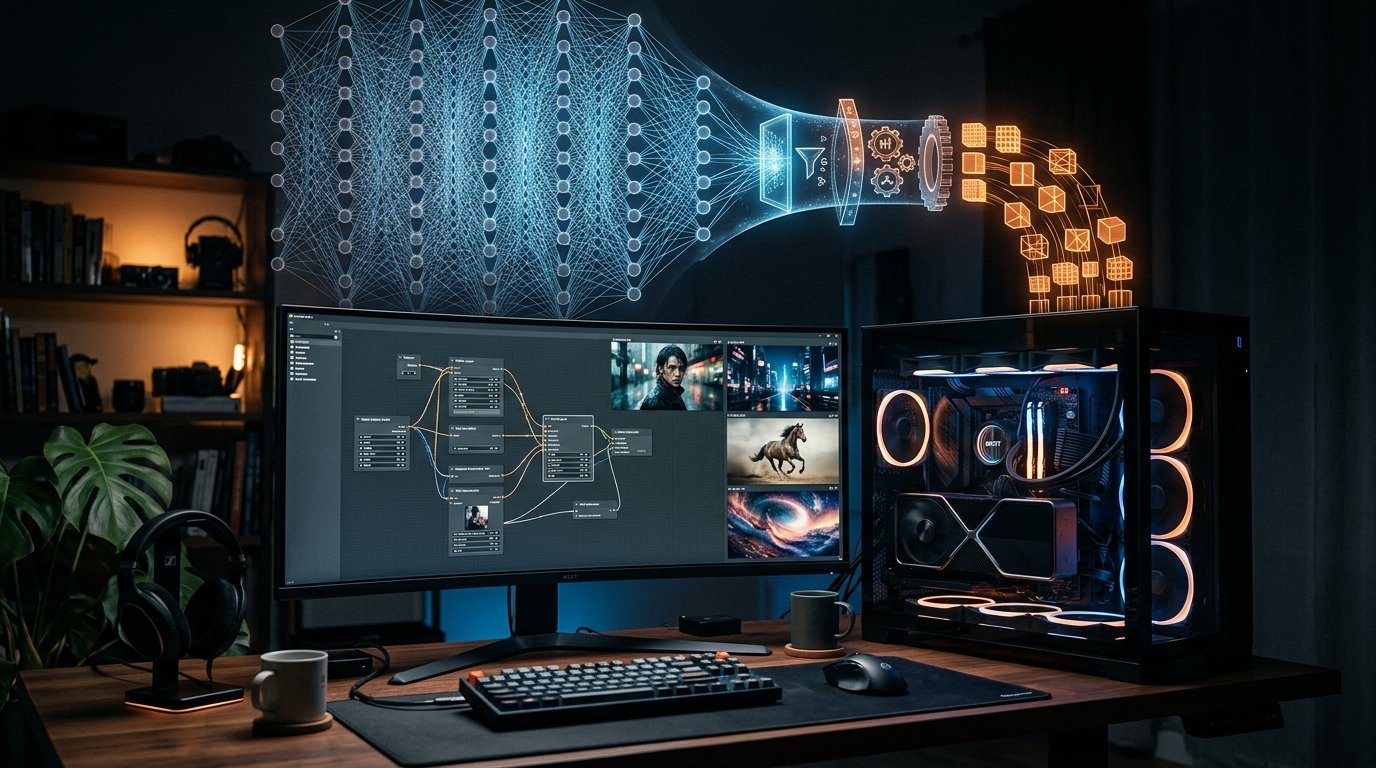
The catch, and it’s a real one, is that you can’t just download a 14-billion-parameter model and expect it to run on a gaming laptop. That’s where a very active corner of the ComfyUI community comes in, repackaging these massive checkpoints into formats that fit on consumer GPUs. We pulled download data from CivitAI to see what people are actually installing right now, and the results say a lot about where open video generation stands in late 2026.
The Numbers Don’t Lie: Wan Owns the Category
Alibaba’s Wan Video line is the runaway leader, with Wan 2.1 (28,132 downloads) and Wan 2.2 (27,404) sitting at the top of the charts, practically tied. That’s not a coincidence. Wan ships under Apache 2.0, comes in a 1.3B size that runs on modest cards and a 14B “MoE” version (split into high-noise and low-noise expert models) that handles the heavier lifting.
The community isn’t just downloading Wan and calling it done, either. The Wan 2.2 T2V A14B GGUF build alone has racked up 6,290 downloads, and workflow guides consistently pair Wan 2.2 with Lightx2v (a 4-step LoRA that slashes inference time) and SVIPro for stitching together longer clips. A 14B model with full expert weights simply won’t fit on a 12GB card without help. GGUF quantization is that help.
Hunyuan and Mochi: The Also-Rans With Good Reason
Tencent’s HunyuanVideo shows up further down the list, but the interesting entry is FastHunyuanVideo720pFP8 (6,077 downloads), a consistency-distilled version from Hao AI Lab that cuts inference from 50 steps down to six. That’s roughly an 8x speedup, and it explains why almost nobody is downloading the base Hunyuan checkpoint anymore. Why wait 20 minutes for a clip when the FP8 version gets you there in three?
Mochi 1 Preview, meanwhile, is aging in real time. It still pulls a respectable 8,128 downloads, but Genmo’s original 10B model wants something like 60GB of VRAM without heavy offloading. It was genuinely state of the art when it launched in late 2024. Two years is a long time in this field.
LTX-2: The New Kid With Sound Baked In
Lightricks LTXV 2 and its distilled LTX 2.3 GGUF build (4,804 downloads, quantized by unsloth) are the newest entries here, and they’re doing something the others aren’t: generating synchronized audio alongside video in one pass, at native 4K. Lightricks says the base model runs on a single RTX 4090, and the GGUF version exists specifically to push that requirement down further for smaller cards.
Why Everyone’s Chasing Quantization
GGUF, FP8 and SVDQuant all solve the same problem from different angles: shrinking a model’s weights so they fit in less VRAM without gutting output quality. FP8 halves precision from the usual 16-bit format. GGUF (borrowed from the LLM world) lets you pick a quantization level, like Q4 or Q5, trading a bit of fidelity for a much smaller footprint. SVDQuant, popularized by the Nunchaku project, pushes things to 4-bit while preserving outlier weights that would otherwise wreck output quality.
That’s also why two Flux checkpoints, Nunchaku Flux 4-Bit SVDQuant and SVDQuant Flux.1 Dev/Schnell, land in this same download data despite being image models. Flux isn’t generating video, it’s generating the starting frame that gets fed into an image-to-video pipeline like Wan or LTX. The line between “video model” and “image model” gets blurry fast once you’re building a real production workflow.
The Practical Takeaway
If you’re setting up ComfyUI this weekend: an 8-12GB card means Wan 2.2 GGUF or FastHunyuan FP8. A 16GB+ card opens up LTX-2’s native builds. Anything less than 8GB, and you’re better off starting with Wan’s 1.3B variant before working your way up. None of it costs a subscription. It just costs patience, and maybe a long download.
Direct Links:
| Model Name | Requirements (VRAM) |
|---|---|
| Wan Video 2.1 (14B) | 24GB native / 8-10GB via GGUF (Q4-Q5) |
| Wan Video 2.2 (14B MoE) | 24GB native / 8-10GB via GGUF (Q4-Q5) |
| Mochi 1 Preview | ~60GB native / under 20GB with ComfyUI offloading |
| Wan 2.2 T2V A14B GGUF | 6-12GB depending on quant level |
| FastHunyuanVideo720pFP8 | ~12GB (FP8) / 8GB via GGUF Q4 |
| LTX 2.3 Distilled GGUF (unsloth) | 8-12GB |
| Wan2.1-Fun-1.3B-InP (i2v) | 6-8GB |
| Lightricks LTXV 2 | 24GB native (RTX 4090 class) |
| Nunchaku Flux 4-Bit SVDQuant | 6-8GB (image model, used for I2V start frames) |
| SVDQuant Flux.1 Dev / Schnell | 4-6GB (image model, used for I2V start frames) |